
For years, aesthetic medicine has been dominated by immediacy. Quick fixes, visible intervention, instant results. But beneath the surface, a quieter shift has been taking place. One that prioritises longevity over volume, regeneration over correction, and biology over illusion. At the centre of that shift is London-based aesthetic doctor Dr. Barbara Kubicka, founder of ClinicBe and widely known among patients and peers as “The Collagen Queen”.
With nearly two decades specialising in skin regeneration, and a background spanning Parisian medical training and the NHS, Dr. Kubicka has become a leading voice in what industry insiders are now calling The Collagen Economy. This year, she launches The Ultimate Collagen Glow, a multi-phase regenerative protocol designed to stimulate the body’s natural collagen production. But as she explains, this is not about a single treatment. It is about redefining how we think about skin health, ageing, and responsibility in beauty.
You are often referred to as “The Collagen Queen”. What do you think that name reflects about the way you approach your work and your philosophy around skin health?
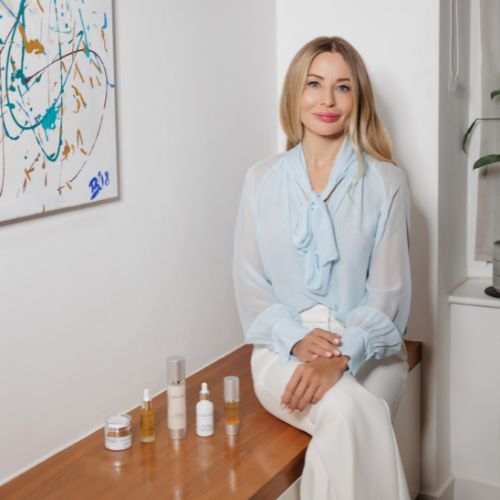
It was never a title I set out to claim, which is perhaps why it feels authentic. Over many years, my clinical focus has consistently returned to collagen as the cornerstone of skin health and ageing well. Patients and colleagues began to notice that my results were not about dramatic transformation, but about skin that looked structurally sound, luminous and quietly youthful.
In that sense, the name reflects a long-term commitment to biology rather than aesthetics alone. It also reflects a philosophy of respect. Respect for the skin as a living organ, and for ageing as a natural process rather than a flaw to be erased. My work is rooted in supporting the skin’s own regenerative intelligence instead of overwhelming it with intervention. Collagen represents long-term thinking. It is about health, resilience and function, not superficial change.
At its core, what does that philosophy look like in practice?
Healthy skin must be built, not imposed upon. My approach has always centred on supporting the skin’s regenerative capacity rather than overriding it with excessive intervention. Collagen embodies resilience, structure and time, and those principles guide how I plan treatments.
Skin health is cumulative. It responds to consistency rather than aggression. What we see on the surface reflects how the skin has been supported over years, not how forcefully it has been treated in moments of insecurity. That perspective changes everything, from consultation to protocol design.
Injectables once dominated aesthetic medicine, particularly in cities like London. When did you first sense patients were ready for something different?
Injectables offered immediacy and control, which made them appealing in fast-paced, image-driven environments. But over time, the industry became overly focused on visible outcomes rather than intelligent ones. That period taught us a lot, but it also revealed the limitations of relying on volume and immobilisation instead of skin quality.
I sensed the shift when consultations became less transactional and more philosophical. Patients stopped asking for a single treatment and started asking for a plan. They wanted to understand how their skin would age, how to preserve its integrity, and how to avoid cycles of constant correction. That curiosity marked a readiness for regenerative approaches that prioritise longevity over immediacy.
You often speak about The Collagen Economy as more than a trend. What does that idea mean to you?
It represents a revaluation within aesthetic medicine. A move away from consumption and towards investment. Investing in the skin’s ability to regenerate and adapt over time rather than chasing short-term results.
Philosophically, it challenges the idea that beauty must be manufactured quickly. It reframes beauty as something cultivated thoughtfully. This shift reflects a more mature relationship with ageing, where preservation and optimisation take precedence over erasure. It also brings responsibility back into the conversation. Responsibility to patients, to medicine, and to the future of the field. Regeneration requires patience, education and trust, which fundamentally changes the doctor-patient relationship. It becomes collaborative, not transactional.
Your background spans Paris, the NHS and nearly twenty years in skin regeneration. How has that shaped how you think about beauty and ageing today?

Those environments exposed me to very different philosophies of care. Paris instilled an appreciation for restraint and holistic thinking. The NHS grounded me in ethics and evidence-based decision-making. Years spent working with regeneration taught me humility. Biology does not rush simply because we want it to.
Together, they shaped a clinical mindset that values precision and long-term outcomes over spectacle. Ageing is not a flaw or a failure. It is a biological process that can be supported. Beauty, to me, is coherence. When skin health, facial movement and identity remain aligned. Looking younger has never been the goal. Looking well cared for, resilient and authentically oneself has.
The Ultimate Collagen Glow is positioned as a multi-phase protocol rather than a quick fix. Why has patience become such an important part of modern beauty?
Because skin regeneration does not happen in isolation or in a single moment. Collagen production and remodelling take time. A phased protocol respects that reality. It allows results to unfold naturally and sustainably, with intelligence rather than force.
People are also more aware of consequences now. We are seeing the long-term effects of overcorrection and short-term thinking. Modern beauty is no longer about instant transformation. It is about how the skin will behave in five, ten or twenty years. Longevity has become the real measure of success.
Many of your patients are creatives and professionals deeply invested in how they show up in the world. What are they asking for now?
They speak about energy, vitality and how their face reflects how they feel internally. There is far less emphasis on erasing lines and far more interest in texture, glow and resilience. Patients want treatments that align with their values. Natural, evidence-based and respectful of individuality.
They are also more informed and more selective, which elevates the consultation process. It becomes a dialogue rooted in trust rather than expectation.
There is a clear shift away from visibly artificial results. Do you see this as an aesthetic preference or a wider cultural movement?
It is both, but it is undeniably cultural. The most sophisticated results are often the least obvious. Artificiality disrupts harmony. Biological enhancement supports it. Subtlety allows for expression, movement and ageing to coexist naturally.
Across fashion, wellness and leadership, there is a rejection of excess and a return to substance. Authenticity has become a form of credibility. In aesthetic medicine, that translates into treatments that enhance rather than disguise, and honour individuality rather than overwrite it.
ClinicBe places education above upselling. Why was that essential for you?
Because aesthetic medicine carries influence and responsibility. Patients often arrive vulnerable or shaped by unrealistic narratives. Education restores perspective. It allows the consultation to become a dialogue rather than a sales interaction.
Treatments should be chosen for the right reasons, at the right time. That is the foundation of ethical practice.
Looking ahead, how would you like this moment in aesthetic medicine to be remembered?
I hope it is remembered as a turning point. A moment when the industry chose depth over speed and biology over illusion. When patients and practitioners embraced a more intelligent, respectful approach to ageing.
If future generations look back and see this as the beginning of regenerative, values-led care that honoured individuality and long-term health, then we will have done something meaningful.
The Final Word
Listening to Dr. Barbara Kubicka, it becomes clear that the rise of collagen-led medicine is not about replacing one trend with another. It is about maturity. A shift towards responsibility, patience and biological respect in an industry that has long prioritised immediacy.
In a beauty landscape increasingly shaped by values rather than spectacle, her work offers a blueprint for what comes next. Regenerative, evidence-based and quietly powerful. Not designed to stop time, but to support the skin through it.
For similar articles, visit TONE Magazine LDN and our Interviews page.